Gandhi Jayanti, observed every October 2, marks the birthday of Mohandas Karamchand Gandhi, the leader of India’s independence movement and one of the most influential figures of the 20th century. In 2026, October 2 falls on a Friday, and it is one of India’s three national holidays, with government offices, banks, and schools closed across the country. It is also observed internationally as the International Day of Non-Violence, a recognition by the United Nations of Gandhi’s philosophy. The day is solemn rather than festive, centered on remembrance and reflection.
The Mahatma’s Legacy
Gandhi was born on October 2, 1869, in Porbandar, Gujarat. Trained as a lawyer in London, he developed his philosophy of Satyagraha, truth-force or nonviolent resistance, first in South Africa and then in India, where he led landmark campaigns including the Salt March of 1930 and the Quit India movement of 1942. His insistence that means and ends are inseparable, that freedom won through violence would be hollow, shaped not only India’s independence but civil rights movements worldwide, from Martin Luther King Jr. in America to Nelson Mandela in South Africa. He was assassinated on January 30, 1948, by a Hindu extremist, just months after independence. Indians call him Mahatma, great soul, and Bapu, father.
How the Day Is Observed
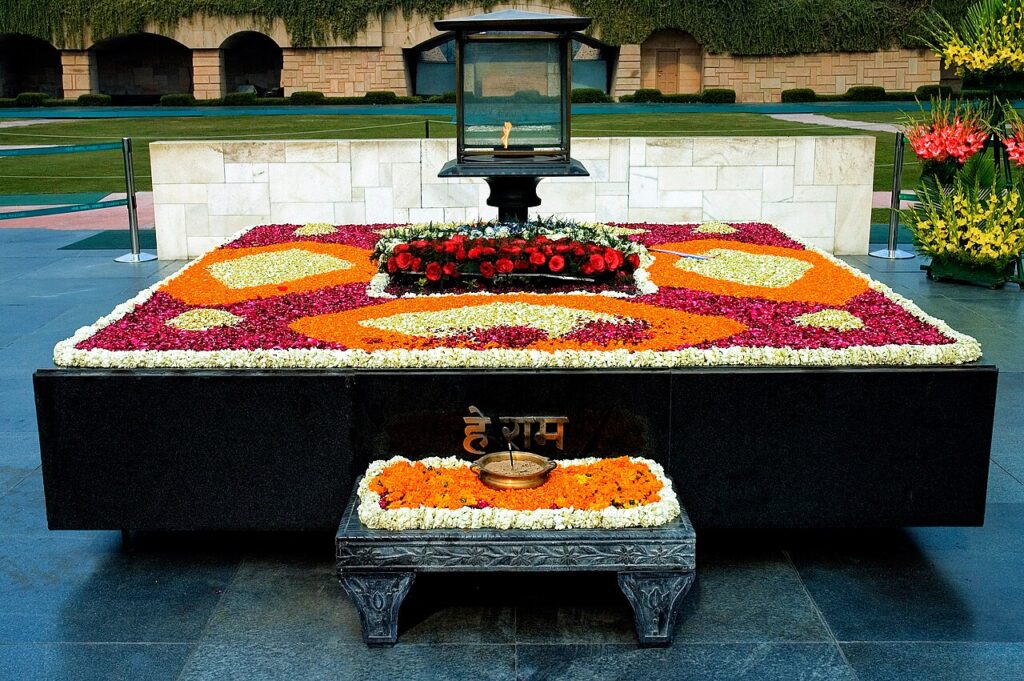
The central ceremony takes place at Raj Ghat in New Delhi, Gandhi’s cremation memorial, where the President, Prime Minister, and other leaders pay homage with flower offerings and a moment of silence. His favorite devotional song, Raghupati Raghava Raja Ram, is sung at memorial meetings across the country. Schools and colleges hold essay competitions, debates, and cleanliness drives, linking the day to Gandhi’s emphasis on self-reliance and hygiene. Notably, the sale of alcohol and meat is prohibited in many states on October 2 as a mark of respect, one of the strictest observance rules attached to any Indian holiday. Government offices organize pledge-taking ceremonies on truth and non-violence.
International Day of Non-Violence
In 2007, the United Nations General Assembly declared October 2 the International Day of Non-Violence, inviting member states to commemorate it through education and public awareness. The resolution passed by consensus, a rare honor reflecting Gandhi’s global stature. Around the world, the day is marked by peace conferences, school programs, and statements from leaders. It is one of very few international days tied to a single individual’s birthday, placing Gandhi alongside a tiny group of universally recognized moral figures. The UN observance gives the holiday a dimension beyond India, connecting domestic remembrance to a global message.
Holiday Status and Practical Notes
Gandhi Jayanti is a gazetted national holiday, confirmed for Friday, October 2, 2026. All government offices, banks, and educational institutions close nationwide. Because it falls on a Friday in 2026, many workers get a long weekend. Visitors should note the alcohol and meat sale restrictions in several states, and expect a quieter, more reflective atmosphere than on India’s other national holidays. Raj Ghat in Delhi is open to visitors paying respects, and the memorial meetings are public. For anyone interested in the philosophical foundations of modern India, there is no better day to engage with Gandhi’s ideas than his birthday.